"I've seen the mountaintop!" shouted a woman blowing a whistle and marching in combat-style boots down Okeechobee Boulevard in West Palm Beach.
"We shall overcome Rick Scott's tyranny!" added a man who followed closely behind, limping a little.
At least 50 members of the disgruntled masses gathered outside the Palm Beach County Convention Center on this brutally warm March morning, when Gov. Rick Scott was about to give a speech. Scott had just introduced some of the budget proposals that would earn him the wrath of citizens across the state. Teachers, police officers, advocates for the disabled, retirees — people from all walks of life would soon be unified in their hatred of Florida's most powerful politician.
By May, a Quinnipiac University poll put Scott's approval rating at a dismal 29 percent. This week, the Broward police union is hosting a "Party to Leave the Party" protest against Scott in which cops who are Republicans plan to switch their voter registration and abandon the GOP en masse.
In response to this widespread discontent, Scott has urged his supporters to send prewritten letters to the editors of local newspapers."Rick Scott deserves our unwavering and enthusiastic support," the letters say. He also uses recorded phone messages to tout his policy decisions, irritating voters with robocalls about pill mills and government spending cuts.
Born in Illinois, Scott , 58, was raised by a truck-driver dad and a mom who worked odd jobs. For about three years starting when he was a toddler, his family lived in public housing — a humble beginning Scott emphasized in his campaign. By the time Scott was 10, his family had moved to a three-bedroom suburban house in Kansas City, Missouri, where he attended high school and college.
He earned a law degree from Southern Methodist University in Dallas and worked for a big firm in town before starting a health-care company called Columbia. He built his fortune at Columbia, eventually merging with Hospital Corporation of America and growing the enterprise to one of the world's largest health-care companies, with more than 340 hospitals and 550 health-care offices in 38 states. But the flush times ended abruptly.
In 1997, as FBI agents raided its offices and hospitals in several states, Columbia/HCA's board of directors forced Scott to resign. The feds alleged that the company had paid kickbacks to doctors in exchange for patient referrals and had overcharged Medicare. The U.S. Justice Department called the resulting criminal case the largest health-care fraud in American history. Columbia/HCA pleaded guilty to 14 felonies and paid $1.7 billion in fines. Scott was never charged.
He did, however, testify in a separate deposition in an unrelated civil case against Columbia/HCA in 2000. When asked basic questions, including whether he was ever employed by Columbia/HCA, Scott refused to answer, citing his Fifth Amendment right not to incriminate himself. In media interviews, Scott has said, "You have to take responsibility for what happens under your watch." But he also said he didn't know the company was doing anything wrong.
In 2003, Scott moved to Naples with his wife. Last year, the multimillionaire ran for governor as a political novice, in a surprise campaign funded primarily by $60 million of his own money. Elected in the Tea Party wave that swept the country, he preached about fiscal austerity and promptly took a knife to cherished social safety nets. In a brief, 60-day legislative session, he implemented a wide-ranging conservative agenda.
He slashed funding for public schools, disabled people, and the unemployed; gave health-care companies control of Medicaid; and privatized nearly all of the prisons in the southern part of the state. Meanwhile, he enacted some of the most restrictive voting laws Florida has seen since the 2000 election debacle.
In June, as the public outcry against his policies continued, one of Scott's top staffers resigned and another was transferred to the state Department of Veterans Affairs. The governor, watching his ship sink, hired a Tallahassee insider as his new chief of staff. He also backed off one of his most controversial executive orders, which required state employees to undergo drug tests.
Despite these changes, the influence of Scott's first, combustible legislative session has already been enormous. Here, New Times takes stock of his dirtiest accomplishments.
Outsourced Prisons to His Political Donors
Last year, the private prison industry gave nearly $1 million to political campaigns in Florida, according to the nonpartisan National Institute on Money in Politics. The majority of the cash went to Republicans, and the largest chunk, $822,000, came from the GEO Group, a Boca Raton-based prison company formerly known as Wackenhut Corrections. (GEO also contributed $25,000 to Scott's inauguration party.) The prison lobby's influence on the Republican-dominated Legislature was immediately evident.
In early February, Scott proposed a plan to transfer 1,500 inmates from state-run lockups to private ones. The next month, lawmakers in the state Senate slipped language into their massive budget bill that privatized nearly all of the state prisons in 18 counties, including Broward and Palm Beach. The budget passed in May, opening the door for the GEO Group and other companies to start bidding for contracts.
Proponents said the prison contracts will go only to bidders who reduce costs by 7 percent, saving the state about $27 million a year. But a legislative analyst who testified before the state Senate in February admitted it was tough to figure out the cost savings, because private and public prisons often operate differently. "They're never apples to apples," analyst Byron Brown said.
And a 2010 study of prisons in Arizona, which also has a cost-savings requirement for its private lockups, questioned whether outsourcing is the cheapest option. The Arizona state auditor found that medium-security private prisons cost $1,200 more per inmate a year than state-run facilities. Reviewing prison studies in other states, the auditor also noted "cost savings from contracting with private prisons... are not guaranteed."
Enacted Jim Crow-Style Voting Laws
After squeaking into office with just 61,550 more votes than his opponent, Scott wasted no time in disenfranchising people who might oust him in the next election cycle. In March, the Florida Clemency Board — composed of Scott, Attorney General Pam Bondi, and other members of his Cabinet — passed a ban on felon voting rights, forcing nonviolent offenders to wait five years after completing their sentences to apply to have their rights restored.
The new rule turned back the clock on Florida's voting laws. During the 2000 election, thousands of voters were wrongfully purged from the rolls because they were misidentified as felons. That mishap brought to light the painful fact that Florida had the largest number of disenfranchised felons in the nation — a disproportionate swath of whom were African-American.
Govs. Jeb Bush and Charlie Crist heeded the outcry over this injustice and made it easier for ex-felons to get their voting rights restored. But Scott undid all their reforms, dismissing the racist implications of his decision.
The felon voting ban dates back to the years just following the Civil War. It was zealously employed — just like poll taxes — to keep African-Americans from voting, says Lance deHaven-Smith, a professor of public administration at Florida State University. "It was used to target and weaken voting rights for blacks, and that is what they're doing with it today," he says.
And Scott wasn't done. In May, the Legislature passed new election requirements that can be used to prevent less-wealthy people — those who work long hours and move frequently — from voting. The law makes it tougher for get-out-the-vote groups to register new voters, requires voters to use a provisional ballot if they have moved from one county to another and not registered the address change before Election Day, and reduces the number of early voting days from 14 to eight.
The American Civil Liberties Union filed a federal lawsuit in Miami seeking to block implementation of the new law. Howard Simon, executive director of the Florida branch of the ACLU, called the law "a trifecta of voter suppression."
Mandated Drug Testing for State Workers and Welfare Recipients
You know something has gone terribly wrong when a concerned group of Key West citizens feels the need to send a communal vat of urine to Florida's governor.
The group, called the Committee for the Positive Insistence on a Sane Society (PISS), collected the urine samples to protest an executive order that Scott issued in March, requiring all state employees to submit to drug tests. "Floridians deserve to know that those in public service, whose salaries are paid with taxpayer dollars, are part of a drug-free workplace," he said at the time.
In June, the ACLU filed a federal lawsuit calling the pee test unconstitutional. Scott suspended the order, pending the lawsuit, although state Department of Corrections employees will still be tested.
He campaigned on, and delivered, a separate law signed in May that requires prospective recipients of Temporary Assistance for Needy Families — cash welfare for families with children — to pass a drug test.This rule struck close to home for Scott. He has a brother in Texas who has struggled with bipolar disorder, has a criminal history that includes drug possession, and now receives social security insurance.
With this law, Florida may be repeating an old mistake. Thirteen years ago the state launched a pilot program to drug-test recipients of cash welfare, and it was an utter failure. Only 3.8 percent of the 8,800 people who took the test failed it. This little government experiment cost the state $2.7 million, and the program was ultimately scrapped, according to PolitiFact.com.
How's that for fiscal austerity?
Fought the Prescription Drug Database
At first, Scott seemed determined to allow Florida's deadly pill-mill addiction to flourish. In February, he proposed repealing the law that created a prescription drug database designed to track the sale of narcotics. He argued that the database, intended to help spot patients who are "doctor-shopping," was an invasion of privacy. His backers in the Legislature also argued that the database didn't solve the problem because doctors weren't required to check it before dispensing drugs.
Still, in a state where seven deaths a day are blamed on prescription drug abuse, Scott's opposition to the database seemed bizarre. Lawmakers and police officials around the country — particularly in states like Kentucky, whose OxyContin drug trade is fueled by Florida's pill mills — bellowed in protest. Even Scott's fellow Republican Attorney General Pam Bondi fought to keep the database. Finally, Scott reversed course and agreed. In June, he signed a law that strengthens criminal penalties for overprescribing drugs, requires pain clinics to register with the state, and prohibits most doctors from dispensing narcotics.
Privatized Medicaid
In Broward County, doctors and patients have been participating in an experiment with privatizing Medicaid since 2006, when then-Gov. Bush enacted reforms he said would control skyrocketing costs and improve care through competition. The pilot program hit many pitfalls, but that didn't stop Scott from signing a law to expand it statewide. Now 3 million of Florida's poorest citizens, including kids, pregnant women, and elderly residents of nursing homes, will learn the joys of dealing with HMOs.
Currently, Medicaid patients either enroll in a state-contracted HMO or visit doctors who accept Medicaid's fee for the services they perform. Under the new plan — proposed by Scott's transition team and sponsored by Sen. Joe Negron (R-Stuart) — patients must enroll in private HMO plans. The HMOs will have more power to change the "scope, duration, and level of benefits," says Laura Goodhue, executive director of the community health advocacy group Florida CHAIN. She fears the HMOs will limit services and deny claims.
In the pilot program that has been operating in Broward and four other counties since 2006, the results have been troubling. According to a 2008 Georgetown University review of the program, a majority of doctors complained that their patients were having a harder time getting care because of the maze of paperwork and limited benefits.
"The complexity of the program has grown, causing confusion and increased administrative burdens for consumers and providers," the report says. "Access to needed services appears to be worsening, according to both physicians and beneficiaries."
"The only way to save money is to delay and deny care," Goodhue says. "People are getting the runaround."
A state-funded study by University of Florida researchers shows that Medicaid expenditures decreased in Broward and Duval counties during the first two years of the pilot program but cautioned, "It is not known whether these savings are sustainable over time."
The saving grace may be that before it can be implemented statewide, the reform plan must be approved by federal officials, because more than half of Medicaid's funding comes from the federal government, Goodhue says.
Acted Sketchy About Solantic
Let's say you're a multimillionaire who amassed his wealth running a health-care company and then decided to run for governor. Immediately after taking office, you start proposing and supporting legislation regarding health-care issues: privatizing Medicaid, requiring drug tests for state workers and welfare recipients, opposing a database that would track the sale of addictive prescription drugs. Unfortunately, the citizens of Florida are not total morons, and they realize that you, as governor, might actually profit from some of these proposals.
Turns out you still own a chain of urgent-care clinics that happen to offer $35 drug tests! Technically the $62 million investment in Solantic is in your wife's name. You moved it to the Frances Annette Scott Revocable Trust a few days before taking office. But it's tough to believe you're not still raking in the dough.
So do you apologize? Do you stage a public mea culpa and admit your conflict of interest? Not if you're Rick Scott. Instead, you wait for the media and the public to get so angry that someone files an ethics complaint against you. Then you rush to sell off your shares in the company. That's not suspicious at all.
Axed Funding for People With Disabilities
Need to trim your budget? There's no swifter solution than taking money from people who are physically incapable of fighting back.
The state Agency for Persons With Disabilities was running a $170 million deficit this spring when Scott decided to start slicing. Tasked with supporting 30,000 people with developmental disabilities, the agency had never been good at living within its means. Since 2005, it has shifted 5,000 clients from its waiting list to its roster but has never sufficiently increased its budget, says Kimberley Thompson, director of community relations for Sunrise Community, a Miami-based nonprofit agency that serves the disabled. Scott insisted he was rescuing the agency by forcing it to tighten its belt.
He issued an emergency order cutting payments to caregivers — the behavioral therapists, nurses, and others who take care of people with cerebral palsy, autism, and other disabilities — by 15 percent. The government sets their fees based on the service they provide — anything from driving clients to the grocery store to speech therapy — so the impact of the payment cut varied widely. But some smaller, nonprofit providers said the cuts would put them out of business, Thompson says.
After a storm of protests from concerned parents and advocates, the state Legislature found a way to temporarily fill the budget gap, and Scott rescinded his emergency order. The agency's funding was restored for 2011, but it now must make 4 percent cuts for the fiscal year that starts in July.
Thompson is glad Scott changed his mind but says the governor and legislators need to learn more about how the agency for the disabled is run and where the money goes.
"I prefer to give him the benefit of the doubt, that he didn't intentionally harm thousands of people around the state," she says. "Once he was educated, he did make a better decision."
Gave Tax Breaks to Businesses; Cut Jobless Benefits
The day after winning the election, Scott announced that Florida was "open for business." He wasn't kidding.
In the budget proposal he made public in February, he suggested lowering the state's corporate income tax rate by 2.5 percent, or $459 million. But an ounce of sanity prevailed in the Legislature, and in May, Scott was forced to settle for a measly $30 million cut. This translated to an average savings of about $1,100 a year for small businesses, although it also gives tax breaks to larger corporations.
Scott and the Republican-dominated Legislature were far less generous to the state's legions of laid-off workers. Florida already has some of the most meager unemployment benefits in the nation — $229 a week — and now those sparse checks will end sooner, after 23 weeks instead of 26. Even more frightening, in the future, benefits will be tied to the unemployment rate, decreasing as the jobless rate goes down.
Yes, you read that correctly. If more people have jobs and are paying taxes, unemployment benefits will go down. For example, when the state unemployment rate is at or below 5 percent, the unfortunate few without jobs can collect unemployment for only 12 weeks. If the Florida unemployment rate reaches or exceeds 10.5 percent (as of May, it was at 10.6 percent), laid-off workers can collect their full 23 weeks of benefits.
This slap in the face to jobless workers was accompanied by a 10 percent cut in the unemployment tax paid by businesses. Thoughtful, no?
Shuns Emails, Reporters, and the Sunshine Law
Rick Scott doesn't hide his disdain for Florida's open government laws. In February, he invited three powerful state Senate leaders to his mansion for a private dinner. They discussed, among other topics, his budget proposal.
This was strange, because when three senators gather to discuss legislative business, Senate rules require the meeting to be open to the public. But the citizens of Florida didn't get a dinner invitation.
In March, Scott scheduled a coffee date with ten legislators. When a Miami Herald reporter inquired about who would be attending and what the politicians would discuss, Scott's spokesman snapped at him, saying the event was "purely social." Then he canceled the coffee date.
Scott, meanwhile, told workers at the Department of Elderly Affairs that he doesn't use email — which is a convenient way to avoid creating a public record of his conversations.
"I don't have email," he said in March. "It's easier if I never get emailed. I get embarrassed by it that way. It's not as easy to communicate."
Before publishing this article, New Times called Scott's press office three times to request an interview. On the third phone call — 11 days after the original request — Scott's press secretary gave a nonanswer.
"We have received your multiple requests, and if we can accommodate that, someone will let you know," Lane Wright said.
But clearly, no one had let us know. Instead, a government spokesman — whose entire job is to answer questions from the public — was employing the silent treatment. "We are not gonna be commenting for this story," Wright finally conceded.
Shocking.
Slashed Public Education Funding
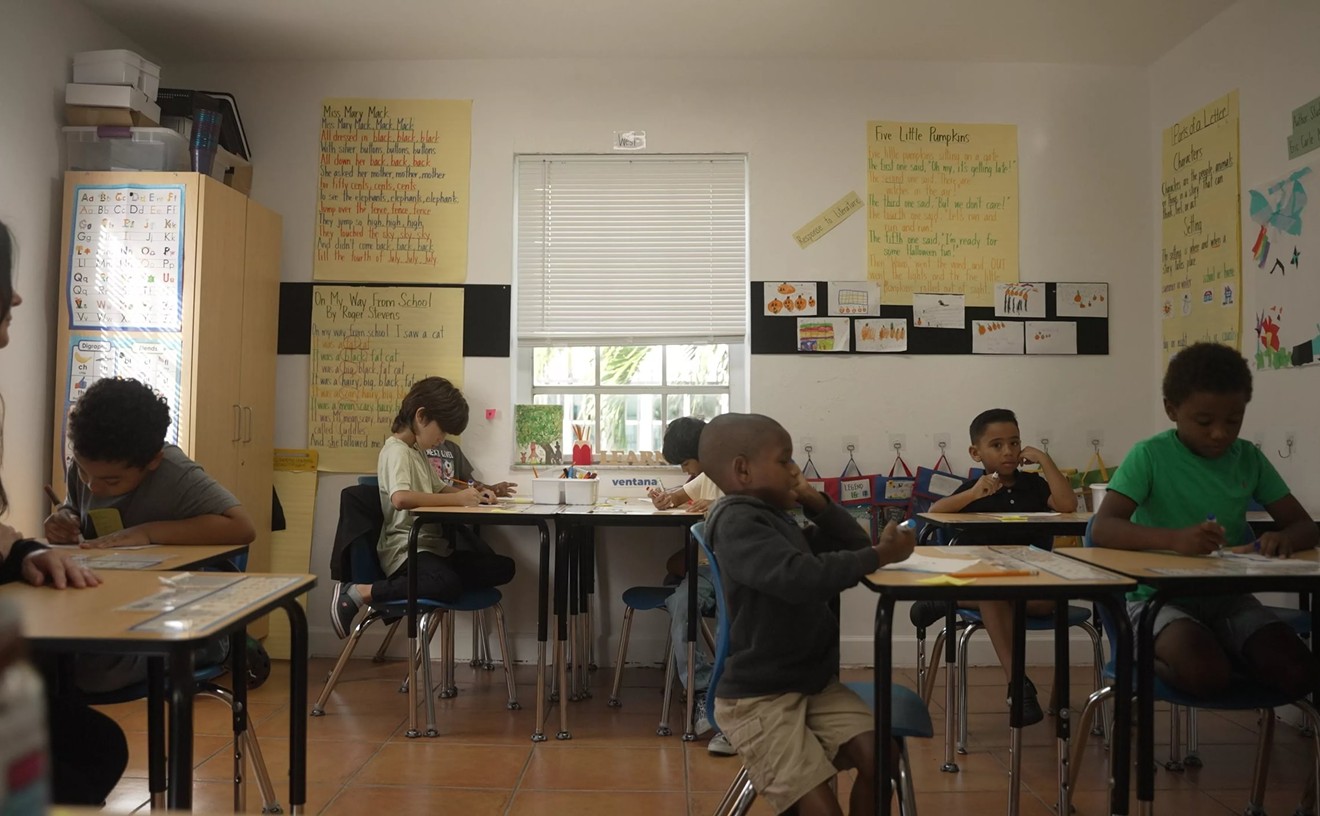
Public schools lost about $542 per student in this year's education budget — an 8 percent funding cut that wouldn't seem so troubling if it weren't accompanied by so many other changes to the education system.
Florida teachers, already some of the lowest-paid in the nation, will now see their raises and job security tied to students' test scores. They will be fired if their annual evaluations are "unsatisfactory" two years in a row, and they will have to contribute 3 percent to their pension funds, a change they consider a pay cut. The merit pay bill, known as the Student Success Act, was a top priority for Scott and was the first to get his signature in March.
Maribah Haughey, a retired teacher who spent 21 years in Palm Beach County schools, was livid about the pay cuts. "All of this is going to drive a lot of young teachers out of Florida," she said. "The salaries suck anyway. What are they making, $30,000 a year?"
Meanwhile, virtual charter schools — which are privately run and publicly funded — were approved under a "Digital Learning" bill that also requires all students to take one online course before graduating. In addition, high-performing charter schools got a break on the fees they must pay to school districts. After signing these school-choice bills in June, Scott promoted them in private and charter schools across the state, telling reporters he now wants to create savings accounts that allow parents to pull their kids out of public schools and pay for private school instead.
Yes, it seems Scott would rather invest taxpayer money in private and charter schools — which are now, thanks to his policy reforms, subject to less public oversight — instead of trying to help the struggling public classrooms where most kids spend their days.
Gutted Environmental Protection Programs
While campaigning for governor, Scott called the Department of Community Affairs, the state agency charged with overseeing local development projects, a "jobs killer." He said he'd heard complaints that development permits were issued too slowly. (That building boom? It was a myth.)
Once he was elected, his transition team made the unabashedly prodevelopment suggestion of merging community affairs with the Department of Environmental Protection and the Department of Transportation, forming a new entity called the Department of Growth Leadership.
That plan never materialized, but the Legislature did follow Scott's lead and start gutting programs. In May, the state Senate quietly passed a bill that killed the Department of Community Affairs, farming out its various duties to other government agencies. The Legislature also agreed with Scott's proposal to chop property tax funding for local water management districts — including a 30 percent, $128 million budget cut for the South Florida Water Management District, the agency charged with restoring the Everglades.
Scott was also determined to end funding for the state's Florida Forever program, which buys land to conserve for parks and forests. State lawmakers proposed a way to rescue the program by selling off surplus land in order to buy more. But in May, Scott used his line-item veto power to ax that plan from the budget.
Lied About High-Speed Rail Money
A proposed high-speed bullet train between Tampa and Orlando wasn't a politically sexy idea. Some critics questioned how many people in this gas-guzzling, highway-loving state would ride a train to Disney World.
But Florida's own transportation department predicted the train would make money from the start, and the federal government was willing to pony up $2.4 billion of the estimated $2.6 billion in construction costs. As gas prices reached $4 a gallon, the train looked more and more like sound public policy.
But Scott chose to believe a study by the Reason Foundation, a libertarian think tank partially funded by oil companies, that called into question the number of people who would ride the train. He feared taxpayers would be on the hook for future costs. His general counsel, attorney Charles Trippe, had told the Florida Supreme Court that $110 million in state funds had already been spent on the proposed rail project.
So Scott sent the money back to Washington.
Only later did the citizens of Florida learn that Scott was fudging the numbers. Turns out the state had spent only $31 million. Trippe apologized to the court, but the money was already gone by then.
About $400 million of Florida's train funds were rescinded by Congress and used to solve the federal budget crisis. The other $2 billion was redistributed to rail projects in the Northeast, Midwest, and California. So our friends in New York, Chicago, and Los Angeles are benefiting now from Scott's creative accounting.
Meanwhile, Scott managed to anger his Tea Party backers by approving the $1.3 billion SunRail, a slower, commuter rail line in the Orlando area. Scott said he feared he'd lose a legal battle if he axed the project.