
Before the songs, chanting, and heartfelt tears, the ceremony next door to a Palm Springs strip mall begins with speeches. A thin, deeply tanned man in a pin-striped suit is among the first to take the microphone. He's not famous — not exactly — but his receding hairline, rectangular face, and over-eager grin are naggingly familiar. "This is a hope factory," he begins. "This is a spiritual experience."
He stands in the lobby of what could be any office building in Florida, beside a reception desk festooned with red, white, and blue balloons. A sea of dignitaries surrounds him — a city commissioner from nearby Lake Worth, the mayor of Palm Springs, school board members, a pastor, teenagers wearing name tags that say "ambassador."
"I stuttered very badly as a kid," he continues, his voice warming to the rhythm of a much-repeated tale. "I was considered a dummy. I empathize with these kids in a very intimate way."
This is Frank Biden, the brother of Vice President Joe Biden. He's here, at a ribbon-cutting event August 31, to promote the first Palm Beach County location of a local for-profit chain of charter schools called Mavericks in Education Florida.
"You are all believers," Biden exhorts the crowd. "This thing spreads like wildfire."
In the past two years, eight Mavericks high schools have opened in Florida, including two in Broward, one in Palm Beach, and two in Miami-Dade counties. In 2011, Mavericks claimed to enroll more than 3,700 students.
The schools, all publicly funded and tuition-free, aim to succeed where many public schools fail. They promise to help kids who would otherwise drop out earn enough credits to graduate.
School districts are eager for the help. Just two-thirds of Florida students graduate — a rate that puts the state 44th in the nation, according to Education Week. The statistics are even worse for African-Americans and Latinos, who make up a majority of Mavericks students in South Florida. Mavericks opens schools in poor neighborhoods, welcoming students of all stripes, including those with jobs and children of their own. By taking online classes a few hours a day, they can earn a diploma.
But so far, Mavericks' lofty goals haven't materialized. Most of their schools graduate less than 15 percent of eligible students. On state report cards, the schools get "incompletes" because so few of their students are taking the FCAT. In Miami, two former teachers filed whistle-blower lawsuits alleging the Homestead school is inflating attendance records and failing to report grades properly.
Plus, there are rampant financial questions, cozy ties between Mavericks and local politicians, and a legal fight with former celebrity spokesman Dwyane Wade.
Mavericks has become a poster child for the problems that have long dogged charter schools in Florida. How can they help troubled kids while also turning a profit, especially when they are run by a man whose brother is next in line for the White House?
"Join us in our mission," Biden says. "If you don't feel a little bit of this energy today, then there's something wrong with you!"
Mavericks' story begins in Akron, Ohio, with a wealthy industrialist who loved to wear big cowboy hats and donate millions of dollars to Republican politicians. In 1998, David Brennan launched White Hat Management. His charter schools were housed in strip malls, and the students herded in to sit at computers for three shifts a day. This was an education model Mavericks would later call the "next generation in education." But state auditors weren't so fond of the company.
For years, the for-profit company refused to reveal how millions of tax dollars were divided between expenses such as teacher salaries and computers, and profits for White Hat. Meanwhile, many of the schools were given failing grades of "academic watch" or "academic emergency" by the Ohio Department of Education.
Last year, the boards of schools in Cleveland and Akron sued White Hat to terminate their contracts, alleging the schools were run without local input and money wasn't reaching the classrooms. This August, an Ohio judge ordered White Hat to open its books for discovery in the suit, but the information has not yet been published.
One of White Hat's early leaders was Mark Thimmig. As CEO from 2001 to 2005, he helped grow the company into one of the largest charter school chains in the country. As of 2010, White Hat had 51 charter schools in six states, including ten charter schools in Florida called Life Skills Centers.
Two years after leaving White Hat, Thimmig alleges in court documents, he was approached by Palm Beach Gardens developer Mark Rodberg about launching a chain of charter schools here. Rodberg had built a few schools for White Hat, but had never run one before. He owned restaurants, including Bucky's Bar-B-Que in Boca Raton and Bucky's Grill in Fort Lauderdale. Together, Thimmig and Rodberg came up with a plan that was nearly identical to White Hat's: Students would attend school but take all their courses online, using virtual technology that required minimal maintenance. Classrooms could hold rows of cubicles with computers where kids would sit elbow-to-elbow. There would be no after-school sports teams, just "cyber-athletics" that allowed kids to play Wii instead of shooting hoops.
In its promotional packets, Mavericks hands out a news story citing a 2010 study by the Schott Foundation for Public Education. According to the study, Broward, Palm Beach, and Miami-Dade counties are among the worst-performing districts in the country when it comes to serving black students. Only 39 percent of black males graduated in Broward in 2008, compared to 58 percent of white males. In Palm Beach, only 22 percent of black male students graduated, and in Miami-Dade, it was 27 percent. By targeting at-risk kids, Mavericks would try to alleviate this achievement gap.
Each school is overseen by a local, nonprofit board. Mavericks in Education Florida LLC then charges the nonprofit hundreds of thousands of dollars in management fees to run daily operations. Mavericks also handles the real estate, charging the schools $350,000 a year in rent.
Rodberg, Thimmig, and the other Mavericks founders drew up an ambitious business plan. The "build out objective" promised to open 22 charter schools by the 2011-2012 school year. The plan mimicked what Thimming had done in Ohio with White Hat. But meanwhile, newspapers in Ohio were questioning how White Hat hid its money and why its schools received failing grades from the state.
Rodberg's sister, Lauren Hollander, later joined the company as manager of Mavericks. She's a real estate broker in Palm Beach Gardens, and became a 20 percent owner of Mavericks in 2008, after lending Mavericks a cash infusion of $1.2 million. She says she didn't hear about the problems with White Hat. "I don't know any of that history, honestly," she says. Hollander says her brother got to know Thimmig while building several White Hat schools.
Rodberg had more than just charter schools in his plans. He was trying to launch a chain of restaurants named after Miami Heat star Dwyane Wade. That partnership led to a bizarre beginning for the Mavericks charter schools.
In August 2007, Rodberg struck a deal with Wade to market a chain of restaurants. Their third business partner was Richard von Houtman, a man who called himself a baron and lived in a Boca Raton mansion purchased with funds from a drug lord. (See "Dwyane's Disaster," New Times July 9, 2009)
Rodberg shut down his Bucky's restaurants and reinvented them as D Wade's Place. They were to be uppity sports bars, with burgers and flat-screen TVs.
"Mr. Rodberg and Mr. von Houtman led [me] to believe that they had much experience and expertise in the restaurant business," Wade later claimed in court, "and that this deal could make everybody a lot of money."
Two months later, a chain of schools was added to the deal with Wade. Rodberg, Thimmig, and a third partner launched "Mavericks High D. Wade's Schools," a soon-to-be chain of charter schools based in Fort Lauderdale. In court documents, Thimmig alleges the plan was simple: He would contribute his expertise and "a design model for the schools." Rodberg would chip in $1 million in cash, take out a $1 million credit line, and would bring in Wade "to make appearances on behalf of the schools."
Hollander says the charters planned to use the basketball star as a celebrity spokesman, encouraging kids to enroll in Mavericks and graduate. "Kids related to him. Parents related to him. Even grandparents related to him! He was the biggest celebrity ever to be connected with the national high school dropout crisis," Thimmig told New Times in 2009.
Aside from the celebrity connection, Mavericks appeared to be White Hat for the Sunshine State. Along with Rodberg and Thimmig, Maverick's third original investor was Cathy Wooley-Brown, a former senior vice president for White Hat in Florida. The company also hired Bonnie Solinsky, who ran a White Hat school, the Life Skills Center of Pinellas County, that closed last year. Solinsky is now Mavericks' director of curriculum.
But pairing schools with a restaurant chain and a basketball star turned out to be a lethal mix. Wade would later allege in court documents that the partners were scheming to cut him out of profits. When they asked him to invest $1 million in the Aventura location of the restaurant, he refused.
According to Rodberg and von Houtman, Wade demanded a higher ownership share of the restaurant chain. When Rodberg and von Houtman refused, Wade refused to show up for photo ops and commercials. The partners sued Wade in December 2008. By then, the restaurants had closed, and Rodberg was losing cash fast. His Millennium Plaza landlord sued him for failing to pay rent on the Fort Lauderdale Bucky's. A Broward circuit court judge eventually ordered Rodberg and Bucky's to pay Millennium Plaza $3.4 million, but Rodberg appealed the ruling and won. This August the Fourth District Court of Appeals ruled the trial court had not properly determined damages, and sent the case back to Broward, where records show it has not yet been resolved.
In March 2009, Thimmig announced Mavericks was also ending its relationship with Wade. The star flaked, didn't appear in TV or radio ads, and wasn't returning calls, Thimmig claimed. Wade's name disappeared from Mavericks' school signs and another lawsuit was filed. Rodberg and Hollander demanded $115 million from Wade for reneging on the restaurant and charter school deals.
Meanwhile, Mavericks' relationship with CEO Thimmig also began to sour. By October 2009, Thimmig had helped Mavericks open four schools — in Homestead, Kissimmee, Largo, and North Miami Beach — and enroll 950 students. Each new student brings in roughly $6,900 in state funding and $700 from the federal government, according to documents Mavericks submitted to the Florida Department of Education.
But Thimmig was worried. He wrote a letter to the company's board warning that although they were turning a profit, they were understaffed and financially struggling. Rodberg never contributed the capital he had promised, Thimmig alleged in court.
Thimmig thought investors who could provide the needed cash infusion were scared off by the Wade lawsuit. "Potential investors did not want to get involved with a company where the principals were suing the other business partners," Thimmig alleged. (Thimmig declined to comment for this article.) He wanted Wooley-Brown, Hollander, and Rodberg to sell their shares of the company to a New York-based private equity firm.
Rodberg and Hollander balked. They accused Thimmig in court documents of "misusing federal and state grant funds," mismanaging the budget, asking Mavericks employees to leave their jobs for other work, and hiring a company that he "owned or had an interest in" to clean the schools. They tried to kick him off the board.
In December 2009, Thimmig resigned as CEO. Then he sued Mavericks for back salary and money he said he lent the company — a total of at least $300,000. He also aired the company's dirty laundry in public court documents. Just two years after its founding, the hope factory was floundering.
Frank Biden sits in a windowless office at the Mavericks High in Palm Springs, leaning over the desk to make his point. It's a sparse, black desk with just a computer on it — no paper, no clutter. The freshly painted blue walls are bare. This isn't Biden's office, just a spare room the school's staff stuck him in to talk to a reporter. Biden, wearing a red tie and dark suit, says it's a "leap of faith" for him to grant New Times an interview, because he doesn't want to embarrass his brother Joe. As he talks, you can still hear the trace of a lisp, the shadow of his childhood stutter.
"Everything I do... I've got to know that it could appear on the front page of the New York Times," Frank says. "Do my best never to do anything to besmirch [Joe's] reputation."
Frank has reason to worry. After serving as a legislative director in the Clinton administration, he worked with Hand in Hand Ministries, which provides scholarships to poor children in Nicaragua. There, he says, he contracted a nasty bacterial infection and came to South Florida to convalesce.
By 2003, however, there were signs of another illness. Around 8:45 p.m. on August 20, 2003, a Broward sheriff's deputy spotted Biden's '88 Chrysler making a wide left turn in Fort Lauderdale. Another driver said Biden had tapped his bumper at a stop light. The cop pulled the Chrysler over to investigate.
Biden's eyes were red, his speech slurred, and he reeked of alcohol. He could not tell the police officer "where he was or where he came from." An open, mostly-empty bottle of Popov sat in his car. Biden lost his balance trying to touch his finger to his nose. A computer check revealed his license had already been suspended four times.
The cop booked him, and Biden pleaded no contest to DUI and driving with a suspended license. He was sentenced to six months of probation, along with six more months of a suspended license. But in October 2003, before the drunk-driving case made it to court, Biden was arrested again, for petty theft.
Employees at a Pompano Beach Blockbuster called the cops when Biden started arguing with them. A sheriff's officer arrived to find Biden trying to leave the store with two DVDs stuffed down his pants. Court records show he failed to appear for a hearing in that case, but documents were not available about the outcome.
A year later, in November 2004, Biden was arrested for a third time in Juno Beach. He pleaded no contest to driving with a suspended license. Rather than spend 30 days in jail, the judge allowed Biden to check into The Watershed rehab center in Delray Beach, where he stayed for three months in 2005.
Today, Biden says he's recovering from his addiction and has been "sober for a long time." "I was an alcoholic. I'm a sober person. I'm very proud of that fact."
By the fall of 2009, Biden was back on his feet, seeking investors for a country club development in Costa Rica that promises to include more than 1,200 homes. Press releases for the project call Biden the "co-developer" and show him smiling beside golf legend Jack Nicklaus, whose name will be on the golf course. Biden says he and his partners own the land, but are still seeking investors.
Meanwhile, back home in South Florida, Biden says he got involved with Mavericks after a simple chance meeting. He says he happened to meet Mark Rodberg in a coffee shop, and the developer told him about Mavericks.
At first blush, Rodberg's litigation record might give a potential business partner pause. He has had 49 civil cases filed against him in Palm Beach Circuit Civil Court in the past two decades. Most of the cases have been resolved, but one pending case, filed in June, alleges he stopped payment on a $4,000 rent check. (Rodberg could not be reached for comment. His only listed phone number is disconnected. When New Times asked Biden about speaking to Rodberg, he said questions should be directed to Hollander instead.)
According to Biden, Rodberg isn't the kind of guy who charms politicians; he's a guy who spits chewing tobacco into a cup. "But he does it eloquently."
After the coffee shop meeting, Rodberg invited Biden to visit a Mavericks school, and Biden says he was hooked. He began flying around the state in a private jet, lobbying school officials and local politicians to support the charters.
He calls himself president and director of development for Mavericks, but his name did not appear on any corporate documents filed with the Florida Secretary of State until New Times began questioning him about it. On December 5, he was listed as president of the company. Frank Attkisson, a former state representative who once ran a state commission designed to approve charter schools that were rejected by local school boards, is vice president. Biden and Attkisson are also both registered lobbyist for Mavericks in Tallahassee.
"I'm a salesman," Biden says. "I'm nothing but a P.T. Barnum for these kids."
With the vice president's brother stumping for Mavericks, the charter school company this year began winning over wary district officials throughout Florida. It joined a booming business. This year, the National Alliance for Public Charter Schools reported there were 462 publicly funded, privately run charters in Florida. And 348 more have applied to open next year, according to the Florida Department of Education.
Many of these schools are designed to earn money. Only Michigan has more charter schools run by for-profit companies than Florida, according to a 2010 study published by the National Education Policy Center at the University of Colorado. Last year, there were 145 schools in Florida run by companies such as Mavericks.
Plenty of government grants help charters grow. Reports submitted to the state by Mavericks show their schools each receive about $250,000 a year in federal grants. And schools that use online curricula are about to get a windfall. This spring, the Florida Legislature, with the enthusiastic support of Gov. Rick Scott, passed a "Digital Learning Now" bill that establishes virtual charter schools and encourages charters to combine traditional classroom instruction with virtual courses, as Mavericks already does. There's even a state grant available for charters to start an "online learning community."
But opening a charter school is far easier than sustaining one. In Florida, at least 192 charters have merged or shut down since 1996. Kids at one charter school in Miami were taught in a tool shed; another school turned into a nightclub after hours. A recent Miami Herald investigation found many schools have high rents and management fees designed to pad the pockets of their owners.
Often these schools struggle academically or financially, yet their management companies are allowed to keep opening new campuses. Gary Miron, a charter school expert and education professor at Western Michigan University, says these problems are worst in states like Florida, with a large number of charters run by for-profit companies. "The problem, as I see it, is that policy makers and legislators have not put in place the right incentives, funding mechanisms and safeguards to ensure that these companies serve the public good," Miron says.
Mavericks' academic failures are glaringly apparent, despite the upbeat assurances of company managers. When asked about the schools' graduation rates, Hollander declined to provide a hard figure. She says the numbers fluctuate when students transfer back to their home high schools. "Our actual percentages are very, very nice," she says. "But it's also unique to each school. We're doing a good job."
Biden says, "We just graduated almost 200 people in one location."
But figures from the Florida Department of Education paint a vastly different picture, showing that Mavericks schools have a worse graduation rate than traditional public schools in Florida. They show Mavericks' best school, in Kissimmee, graduated just 43 percent of the eligible kids in June. Other Mavericks schools performed far worse. Mavericks High in North Miami Beach had a 12.7 percent graduation rate last school year. In Fort Lauderdale, the rate was 13.1 percent, Largo's was 7.2 percent, and in Homestead it was 4.5 percent.
On Florida's state report cards, Mavericks schools in Miami-Dade, Pinellas, and Osceola counties have all scored "incomplete" because not enough students have taken the FCAT. Hollander says she expects the FCAT grade to change as more students enroll.
Deborah Higgins, a spokesperson for the state Department of Education, said there is no policy that requires a school to be disciplined or shut down if it continues to earn grades of "incomplete." That means Mavericks schools can keep operating with little oversight of its academic progress.
Part of Mavericks' problem may be the teaching model: Parking troubled kids in front of a computer and hoping they'll learn — instead of watching the latest Kardashian stunt on YouTube. Research shows that for virtual learning to work, "Students need to be very self disciplined and have supportive environments," Miron says. "If they're not self-guided and self-motivated, then it's gonna be a hard match."
Meanwhile, recent lawsuits filed against Mavericks raise questions about whether any of the schools' statistics can be trusted. In February and June of this year, two former employees filed whistle-blower lawsuits against Mavericks regarding its Homestead high school. Teacher Maria Del Cristo and career coordinator Kelly Shaw allege the school inflates attendance records to receive more money from the school district, exceeds class size limits, and "regularly fails to accurately post grades and report student enrollment" in the district's computer system, in violation of state law.
State school funding follows students, no matter where they are enrolled. When entering data into the computer system, the lawsuits allege, Mavericks often says students are enrolled in courses they're not actually taking in order to get more funding. Even more alarming, Shaw and del Cristo allege the school does not offer a "Florida High School Diploma."
Records show Mavericks schools are not accredited by the Southern Association of Colleges and Schools Council on Accreditation and School Improvement. This means graduates can attend community colleges, but they may have trouble getting sports scholarships or federal grants.
Students would ask Shaw if they could check their records, to see what courses they were enrolled in. But the school principal, Candace Chewning, told her to "calm the wildfires" and deny students and parents access to the records, Shaw alleges.
Chewning also chastised Shaw for warning students they might not be accepted into certain programs with a Mavericks diploma. According to Shaw, her boss told her she was spreading "poison" in the school, and Mavericks might close because so many kids were leaving. Shaw was fired in February 2010.
In April 2010, Del Cristo called the Miami-Dade school district to complain about students grades and attendance records being altered, among other allegations. She was fired the next month.
Dale Morgado, attorney for Shaw and Del Cristo, declined to comment, saying he's in settlement negotiations with Mavericks.
Mavericks officials have filed motions to dismiss both lawsuits. Biden says Mavericks schools issue Florida diplomas, but not every child graduates. When New Times contacted Hollander to ask more detailed questions about the lawsuit and other issues, she never responded.
Mavericks' paper trail is also troubling. Accountability reports, submitted by Mavericks to the state, contain bizarre financial figures. In 2010, the reports show zero dollars in revenue for the school in North Miami Beach, while both Mavericks schools in Miami-Dade claimed to be paying most of their teachers less than $5,000 a year.
Tammy Lara, principal at Mavericks High in Homestead, says those salaries are no longer correct. "Our salaries are very competitive to Miami-Dade County public schools," she says.
But Lara was not head of the school last year when the reports were submitted and didn't know why the listed salaries were so low. Hollander said she was unfamiliar with the state reports and would have to review them before commenting. When emailed the reports, she never responded.
Money has long been a problem for Mavericks. At the Fort Lauderdale Mavericks in June, independent auditors found the school met state criteria for a "financial emergency,"with a net deficit of at least $520,000. At the same time, an audit showed that the North Miami Beach Mavericks was $400,000 in debt and had borrowed from the Mavericks management company to stay afloat. The state department of education also required the Mavericks school in Pinellas to create a financial corrective action plan.
Mavericks officials say Fort Lauderdale's debt was temporary, because the school's original enrollment was low. Hollander wrote a check to cover the budget hole, and the school is "now on its feet and very healthy," Biden says.
By law, school district officials can shutter charter schools with serious academic or financial problems. But Mavericks has managed to avert the worst penalties by submitting plans to correct its finances and by earning "incomplete" instead of "D" or "F" on its state report cards. Plus, Florida law is designed to encourage charters, not shut them down. Even failing schools are given time to improve before they are closed.
John Schuster, spokesman for the Miami-Dade school district, says no action has been taken against Mavericks there. "The district monitors charter schools' academic and financial performance. In general, it takes two years of poor performance data to result in closure."
Both Miami-Dade Mavericks schools have been open since August 2009. The Broward and Palm Beach schools are newer, and thus do not have a two-year track record.
The management fees paid by the individual schools to Mavericks in Education Florida have been a source of controversy. School district officials want to know what the fee will be before they approve a new school, but it's not always clear. Last year, the management fee was $267,000 for the Fort Lauderdale Mavericks school. In 2010, Mavericks in Homestead paid the management company $418,000, or 17 percent of its state funds. In Palm Beach County, Mavericks' fee is not specified in its contract. Hollander says the fee varies based on enrollment, but it's capped at 11 percent of the state funding the school receives.
According to Biden, Mavericks turns a profit because of its savvy real estate choices. "It's all about the buildings we buy," he says."Certainly the operation of the schools isn't profitable."
But most of the time, Mavericks isn't buying buildings. It's striking deals with private landlords, then charging individual schools rent of $350,000 per year for five years, regardless of the price of the building. That's the case in Homestead, North Miami, Kissimmee, and Pinellas. In Homestead, the school building's current market value is $1.2 million, but the school is on the hook for $1.75 million in rent over five years.
That sum, combined with its management fee, means the Homestead school paid 28 percent of its revenue to Mavericks in Education in 2010.
Hollander says Mavericks does not want to be the go-between, collecting rent from the schools, but it's tough for a landlord to "wrap his mind" around a five-year lease.
Mavericks cut out the middle man when negotiating a lease in Fort Lauderdale. Charles Barnett, Mavericks' secretary, bought a building at 424 W. Sunrise Blvd. for $2.2 million. Barnett, a lawyer in Palm Beach Gardens, purchased the building with a newly formed corporation called School Property Development LLC. The manager of the corporation is Charles Berle, who also sits on the board of the Mavericks school in Palm Springs.
Hollander says Barnett bought the school because they couldn't strike a rental deal with the previous owner.
According to Miron, the Michigan expert on charter schools, it's common for "separate but connected companies" to own the buildings that house charter schools. "A lot of profit comes from equity accrued in the facility, or above-market leases that are paid to the company that owns the facility," Miron says.
To lease the Fort Lauderdale property, Barnett's company, School Property Development, charges Mavericks High of Central Broward rent. The cost: $350,000 a year.
In June 2010, Hollander and Rodberg reached an undisclosed settlement agreement with Wade. With the fight behind them, they focused on growing Mavericks.
Yet not every school district was eager to put faith in Mavericks. Hernando County officials turned down Mavericks' charter application three years ago, partly because of questions about Mavericks spending. And for two years, Palm Beach County school district officials refused to approve a Mavericks school, saying the charter applications didn't meet state standards.
In February, district staff once again recommended denying Mavericks' application to open the school in Palm Springs. Staffers said the school's budget projections were "not realistic," objected to the management fee not being specifically defined in the contract, worried about the Pinellas school's financial difficulties, and noted that four existing Mavericks schools "contain deficiencies in their Accounting Policies and Procedures."
"The District prepared an analysis to reflect missing personnel and other operational costs," staffers wrote to the School Board."The net result is a loss putting the charter school at risk for being in financial emergency."
If these monetary concerns were not enough, then-Superintendent Art Johnson said history had taught district officials to be strict in their evaluation of charters. "We need to make sure that we don't have people coming in here with an educational mission and then turning it into a business plan to make money," he told the board.
Biden later told New Times he met with each school board member before the vote, telling them Mavericks would be an "adjunct" to the public schools. 'We, over a period of a year, convinced everybody in Palm Beach County of of our good intentions," he says.
He also points out that every time a student graduates from Mavericks, they boost the school district's overall graduation rate. "So naturally they [the districts] love us."
Palm Beach school board members, presiding over a district where so few minority students graduate, swooned over Mavericks' pitch to help at-risk kids.
"I want to give every opportunity I can to underprivileged kids," said board member Monroe Benaim at the public meeting in February.
"I'm willing to take a risk," board member Karen Brill chimed in.
"We've got to be able to not leave anybody behind," added board member Marcia Andrews.
School Board member Chuck Shaw abstained from the vote. As a former charter school principal, he said he'd done some "volunteer work" for Mavericks and helped them with their charter application. He later emailed a statement to New Times that stated: "I was not involved in the writing, editing or creation of their charter, just gave my opinions since I believed that their focus was good."
What Shaw didn't mention at the public meeting was the money he'd received. At a 2010 campaign event, he collected $750 in campaign donations from Mavericks employees and their families — including Biden, the Hollanders, and the Rodbergs.
At the School Board meeting, a parade of Mavericks officials and supporters spoke in defense of the school. There was prominent African-American pastor Cedric Mays of the Baptist Ministers Conference of the Palm Beaches, and Atkisson, the former state representative. Of course, Biden was there too, invoking his family's political power.
"I give you my word of honor, on my family name, that this system is sustainable," he said. "This school will be sustainable."
The board approved the school 5-1, with only one member dissenting. Dr. Debra Robinson said she supports Mavericks but thought it was unfair for the board to overrule staff objections for one school, without re-evaluating all the other charter schools that had been recommended for denial this year. She even called out Biden for his influence on the vote.
Because people have big dogs that lobby for 'em, we are able to see better?"she said. "No. I see it as an exception to the rules."
Back at the August ribbon-cutting at Mavericks High in Palm Springs, Biden finishes his speech. A young woman wearing silver hoop earrings and sparkling pink Converse sneakers takes the mic. "All I want to do is get my education," she tells the crowd. She takes a deep breath and begins to sing.
"I'm focused, I'm ready to win," her voice trembling and clear."If I stumble, I won't hit the ground. They can't bring me down."
Now the room is hushed. The next speaker is petite and striking, with closely cropped hair, ebony skin, tattoos on her arm, and a stroller for her baby. "I want to be a great role model for my daughter," Ebonee Parker says, her voice breaking with tears. "She's the reason why I'm standing here before you."
Parker leaves the stage, but the parade of performers continues. Eight Mavericks students stand to recite the school's pledge. They are a Benetton commercial of racial diversity — blond, brown, male, female. "I am the person that directs my destiny," they pledge. "I am the best that this world has to offer. I will believe in myself even when others do not."
Finally, a small band of African-American men, including Pastor Mays, performs another song they wrote for the occasion. "You've got something good, you've got Mavericks High!" rings the chorus. The crowd begins to clap. Harmonizing voices fill the room, bringing warmth to the stale fluorescent lights and linoleum floors.
By the time everyone heads outside to cut an enormous turquoise ribbon, Liz Downey, the school secretary, has tears in her eyes. She has good reason to celebrate. Another Mavericks school was approved in early November in Orange County, and two weeks later Palm Beach County district officials would recommend approving three more. However, the Palm Beach vote was postponed after New Times published a blog about the schools.
District spokesman Nat Harrington says board members delayed the vote because they wanted more information about the grades and graduation rates at the eight existing Mavericks high schools in Florida. "Based on the information staff has received to date, there are reasons to be concerned about the strength of Mavericks' academic program," Harrington wrote in an emailed response to New Times' questions.
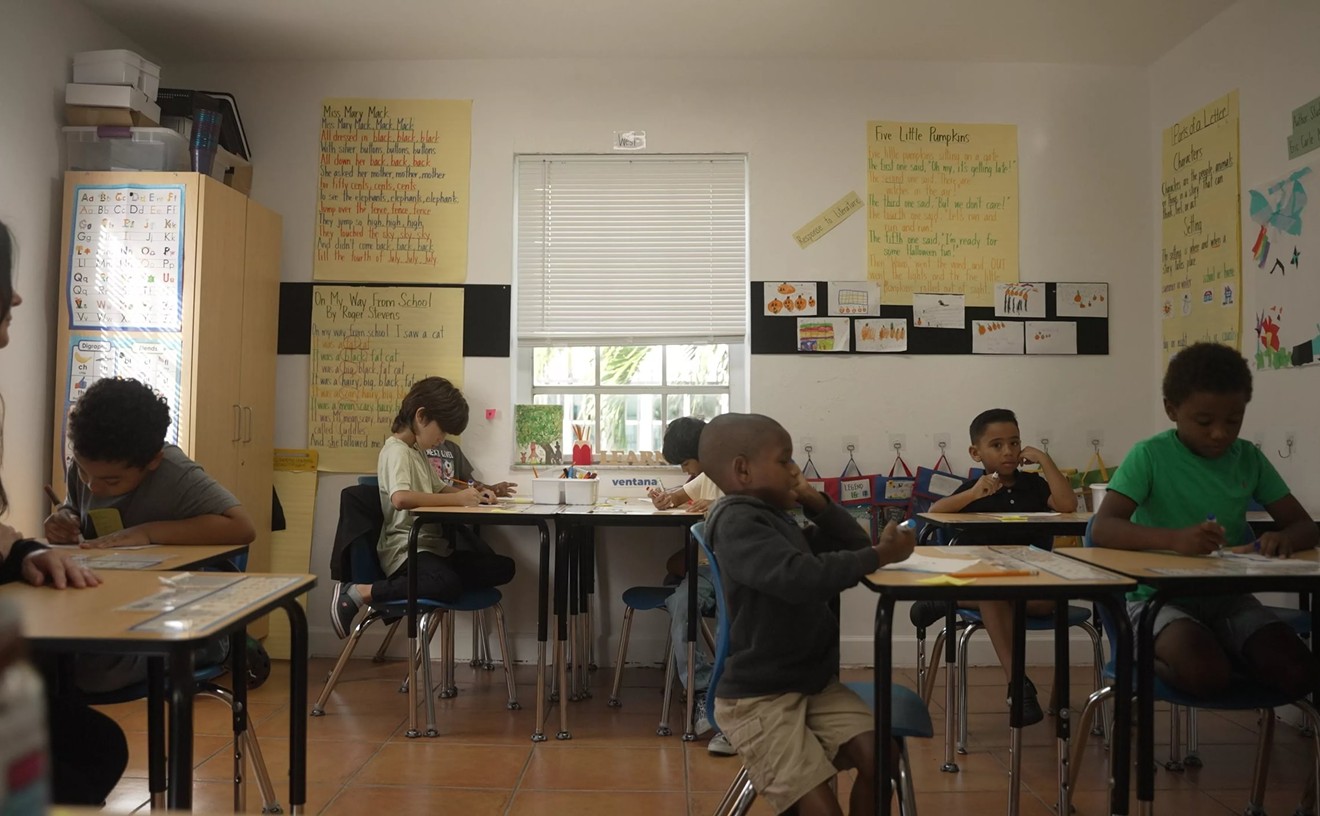
After cutting the ribbon, the crowd heads inside for cookies and tours of the school. Students fill the cubicles that weeks earlier had housed only rows of computers. Their teacher urges the class to listen carefully, because they have visitors.
A student sitting by the window looks confused. She has been stuck in class studying while all the singing and speech-making filled the lobby. "What they havin'?'" she asks a random visitor. She had no idea there was a celebration today.